

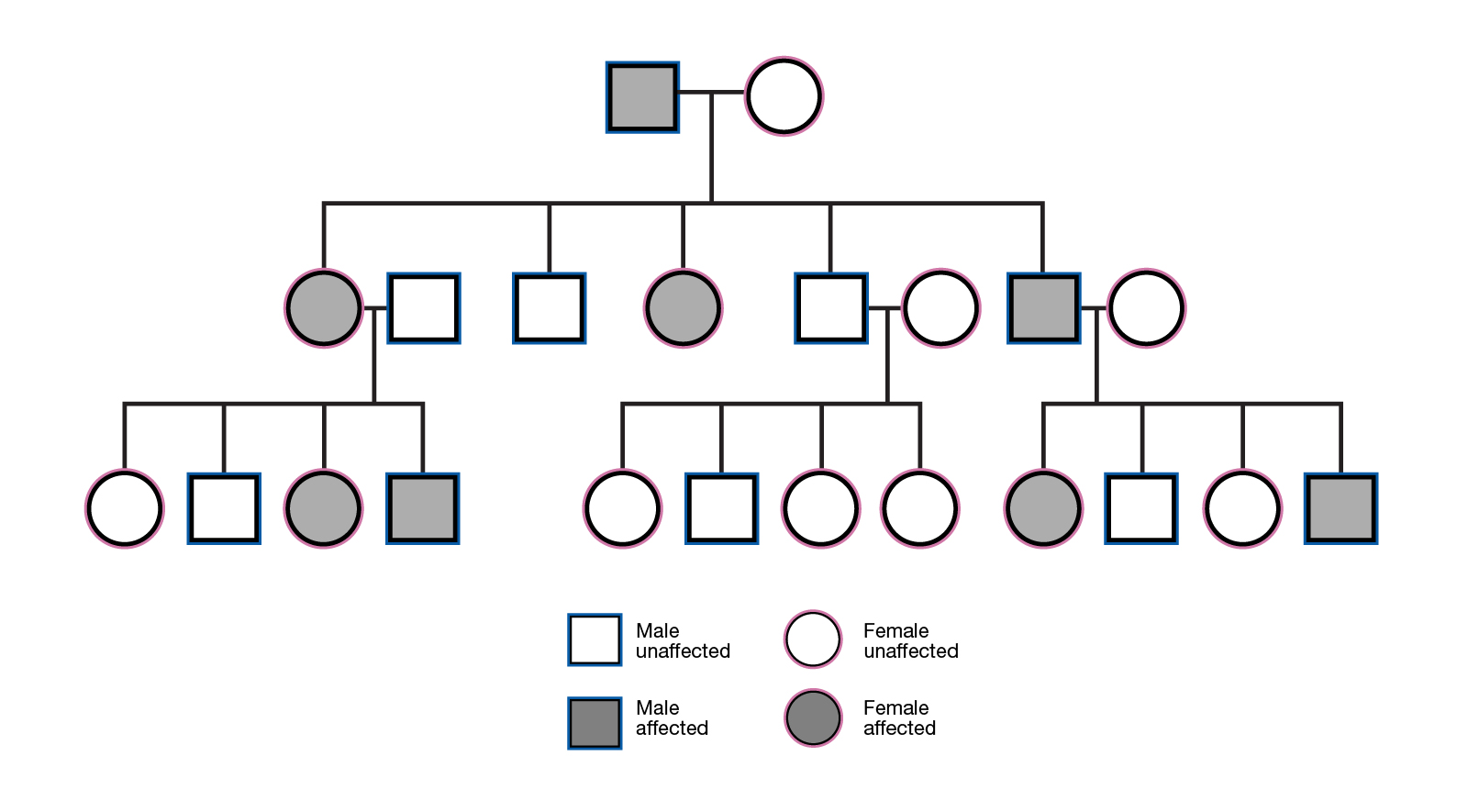
The classes of intestate succession are regulated by law and consist of the circle of relatives of the decedent. Their main characteristic is the exclusion of persons of one class from the estate where there are persons capable of inheriting who belong to a preceding class.
First: In the first class of intestate succession, the descendants of the decedent are called to inherit. The descendants are distributed by stirpes (per roots); for example, the root includes the son, then the grandson, and then the great-grandson.
The closer descendant excludes the more remote one of the same root; that is, in the example, the son excludes the grandson. If the closest descendant is no longer living, the next more remote descendant takes his place; that is, the grandson takes the place of the son (his father) who is not living at the time of the devolution of the inheritance.
Second: The second class includes the parents of the decedent together with his siblings, as well as the children and grandchildren of the siblings, where the latter are no longer living.
Third: The third class is composed of the grandfathers and grandmothers of the decedent and, among their descendants, the children and grandchildren.
Fourth: This class of intestate succession is composed of the great-grandfathers and great-grandmothers of the decedent.
The surviving spouse is called to inherit alongside the relatives of the first class at a rate of 25% (1/4 of the entire estate) and alongside the relatives of the remaining classes at 50% (1/2). The spouse always receives, regardless of class, the furniture, household utensils, clothing and other domestic items that the spouse used either alone or jointly with the deceased spouse. The spouse may be excluded from intestate succession if the decedent, before his death and having a well-founded ground for divorce, had filed a divorce action.
Fifth: In the fifth class — that is, where there are no relatives of the first, second, third or fourth class — the surviving spouse alone is called as heir to the entire estate.
Sixth: In the sixth class, where there is no relative of the remaining classes nor a surviving spouse, the State is called to inherit. The State, moreover, has no right of renunciation of the inheritance, reinforcing the principle of legal certainty in transactions, so that the decedent’s estate does not remain unexploited and dormant.
- See also article Certificate of Inheritance
- See also article Renunciation of Inheritance by a Minor
FREQUENTLY ASKED QUESTIONS ON CLASSES OF INTESTATE SUCCESSION
1. Which class do I belong to and what share do I inherit?
Classification is based on the kinship relationship with the decedent. The first class comprises the children and descendants, the second the parents and siblings, the third the grandfathers and grandmothers, the fourth the great-grandparents, and the fifth the surviving spouse alone. The basic rule is: the existence of even a single heir in a preceding class entirely excludes the relatives of subsequent classes.
The surviving spouse receives 1/4 when concurring with descendants (first class) and 1/2 when concurring with the remaining classes, and always receives the household items. The exact calculation depends on the number of co-heirs in the same class.
2. What does succession per stirpes mean and how does it affect me?
Succession per stirpes (by roots) means that if a descendant (e.g. your father) has predeceased the decedent, his own children (you and your siblings) take his place, sharing the portion he would have received. Each does not receive an equal share with your living uncles; rather, the share of your predeceased parent is divided equally among the siblings.
This principle applies in the first and second class and has significant practical consequences for the calculation of shares, particularly where there are several grandchildren from different children of the decedent.
3. How much time do I have to renounce or accept the inheritance?
The time-limit for renunciation is four months from knowledge of the devolution and its cause, extending to one year if the decedent had his last residence abroad or if the heir learned of the devolution while residing abroad. Lapse of the time-limit without action is equivalent to tacit acceptance, with the consequence that you become liable also for the debts of the deceased.
Where the heirs include minors, the time-limit begins to run upon their attaining majority, but there are special rules that should be examined in good time.
4. What documents are required for acceptance of an intestate inheritance?
The following are required: a death certificate, a certificate of next of kin, a certificate of non-publication of a will issued by the Court of First Instance, a certificate of non-renunciation, as well as title deeds of the real properties together with cadastral sheets and topographical diagrams. An inheritance tax return must also be filed with the competent tax office (DOY) within nine months of death (or one year for residents abroad).
A notarial deed of acceptance, registered with the Land Registry/National Land Registry (Ktimatologio), is necessary for the transfer of real rights into the name of the heirs.
5. How can I claim my share if I have been omitted?
If you are a lawful heir and a co-heir has unilaterally proceeded with acceptance without including you, you retain the right to bring an action for the inheritance (hereditatis petitio) under Article 1871 of the Civil Code (AK), seeking recognition of your status as heir and restitution of the inheritance assets. The success of the action depends on proof of the kinship relationship, the absence of a will or ground for disinheritance, and observance of the twenty-year limitation period.
In addition, if you are a child, spouse or parent, you retain in any case the right to a forced share equal to one-half of the intestate share, which is protected even against a will.
6. What is the role of a lawyer in handling intestate succession?
The lawyer verifies the chain of kinship and determines with precision the classes and shares, identifies any problems with the title deeds, coordinates with the notary public for the deed of acceptance, and files an application for issuance of a certificate of inheritance where required. The lawyer also assesses whether acceptance or renunciation is preferable, particularly where there are debts or outstanding tax liabilities of the deceased.
In cases of disagreement among co-heirs, the lawyer undertakes the judicial partition or the action for the inheritance, and may also handle disputes regarding the forced share or the validity of a will that may emerge subsequently.
[7392]1xbey Login PH | Legit Online Slots at GCash Casino,Mag-1xbey login ph na para sa legit online slots gcash. I-download ang 1xbey app at alamin kung paano maglaro ng baccarat. Mag-sign up na at magsimulang tumaya! visit: 1xbey