


The Hague Apostille is the certificate required to attest the authenticity of the signature and the capacity of the signatory.
I. What is the legislative framework of the Hague Apostille Convention?
What is the Hague Apostille?
The Hague Apostille is the certificate which, pursuant to the Hague Apostille Convention (5 October 1961), must be affixed to public documents by the State that issued them, in order to attest the authenticity of the signature, the capacity in which the signatory acted and, where applicable, the identity of the seal or stamp borne by the document.
The issuance of the Hague Apostille is a fundamental prerequisite for public documents to be accepted between any State that has acceded to the Convention and any other States that have not raised objections to that accession (see the list of States that have acceded to the Convention).
Greece ratified the above Convention by Law 1497/1984 – Government Gazette A’ 188/27-11-1984.
See the official handbook on the practical operation of the Convention concerning the apostillation of documents here.
For the issuance of the Hague Apostille, a specimen signature of the signatory of the public document must be on file, with the exception of documents bearing an advanced electronic signature (digital signature) PP1, in accordance with the provisions of Articles 2 and 3 of Presidential Decree 150/2001 – Government Gazette 125 A’/25-6-2001.
The following are considered public documents under the Convention:
● Documents emanating from an authority or public official of a judicial body of the State, including documents emanating from a public prosecutor’s office, court clerk or bailiff.
● Administrative documents.
● Notarial documents.
● Official certifications affixed to private documents (attestations, endorsements, certifications).
See also: Establishment of an Apostille Office of the Hague Convention by the Decentralised Administration of Attica
Where the documents are to be sent to a State that is not a member of the Hague Apostille Convention or to a State against which Greece has raised objections, the route followed is certification of those documents by the supervising Ministries and subsequently by the Ministry of Foreign Affairs.
II. Which authorities are competent to issue the Hague Apostille?
Pursuant to the provisions of Article 280, paragraph 1, of Law 3852/2010, Government Gazette 87/A’/7-6-2010 (of the founding Law 2503/1997 – Government Gazette 107 A’) and of Article 186 of the said Law, as well as of Law 1497/1984 – Government Gazette A’ 188/27-11-1984, which ratified the Hague Convention, the authorities that issue the Apostille under Article 3 of the Hague Convention are:
1. DECENTRALISED ADMINISTRATIONS
They apostille public administrative documents of the public civil services of the prefecture which do not fall within the competence of the elected region, the documents of legal persons under public law (NPDD), as well as documents of first-tier local government organisations and registry offices.
2. REGIONS
They apostille the documents of the regional services.
3. COURTS OF FIRST INSTANCE
They apostille documents of a judicial nature.
3. How is the Hague Apostille completed?
● Completion of the ten (10) numbered standardised items of information.
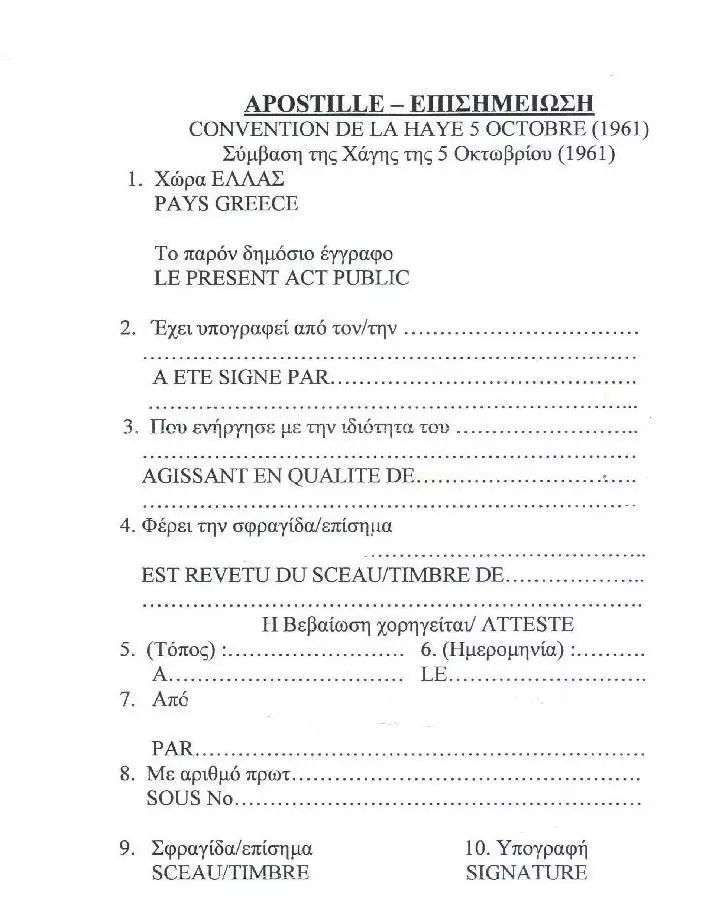
Each item must be completed to the extent that the relevant information is available. No item should be left blank, and if an item does not apply, it should be marked as “not applicable”.
● Language of the added information
The Competent Authority may complete the ten (10) numbered standardised items of information in English, French or in the language of the Competent Authority (if neither of the first two), or in another language. Completion in English or French is generally encouraged to ensure that the apostille is valid abroad (see Conclusions and Recommendations, no. 90 of the Special Commission, 2009). The title (Apostille, Convention de la Haye 5 Octobre 1961) must be stated in French.
● Multiple documents
The apostille certifies only the authenticity of the signature/seal of a single official or authority. Consequently, a single apostille cannot be issued for multiple documents prepared by different officials. For practical reasons, certain Competent Authorities issue a single apostille for multiple documents that have been grouped together, where each document in the bundle is prepared by the same official or authority.
● Signature
The Convention does not specify the manner in which apostilles must be signed. In practice, printed apostilles are signed by hand (physical/handwritten signature), by affixing a stamp, by technical means (signature simulation), or by electronic signature, using a digital certificate.
● Electronic Apostille (e-APP)
Since April 2006, a handbook on the electronic Hague Apostille has been issued, which was renamed (e-Apostille). It has been gradually applied since 2012 by several Member States of the Convention. The programme offers security, simplification of procedures and economy, in accordance with the Hague Convention.
The Electronic Apostille Pilot Programme (e-App) consists of two distinct platforms:
a) The issuance of electronic Apostilles using PDF technology for issuance and signature with the assistance of an electronic certificate.
b) The capability of each Competent Authority to record all apostilles it issues, regardless of whether they are issued on paper or in electronic form, in an electronic register. In this way an issuing authority can verify the origin of the relevant Apostille issued by another authority.
The electronic Apostille effectively contributes to the resolution of future problems (such as the apostillation of electronically issued documents, etc.). Greece accepts the electronic Apostilles of States that apply them and has not raised objections in this respect.
III. Categories of documents
A. PUBLIC DOCUMENTS
The Hague Apostille is issued on original public documents or on certified copies issued by the issuing authority that have the force of an original (Ministry of Interior 47302/26-8-2008). Where issuance of a certified copy is not provided for (e.g. driving licence, destruction protocols, old documents of administrative force, etc.), the apostille is issued on a certified photocopy authenticated by the issuing authority.
● DOCUMENTS OF MUNICIPALITIES AND REGISTRY OFFICES
– Birth certificates
– Family status certificates
– Marriage registry acts
– Marriage licences
– Other documents
These are apostilled by the Decentralised Administration, within the time limits set by the various services (Ministry of Interior F.131360/8297/5-6-2014).
The following documents are exempt from the apostille requirement:
– Personal status
– Legal capacity
– Family status
– Citizenship
– Residence, domicile
– Acts or documents relating to the celebration of marriage
– Issuance of marriage registry act
where these originate from countries that have ratified the Convention on the Exemption from Legalisation of Certain Acts and Documents, 15-9-1977 (Ministry of Interior 22746/3-6-2014, Government Gazette 19 A’, Law 4231/2014).
The countries that have ratified the said convention are: AUSTRIA, FRANCE, GREECE, SPAIN, ITALY, LUXEMBOURG, THE NETHERLANDS, POLAND, PORTUGAL, TURKEY.
These acts and documents shall be accepted without legalisation or any equivalent formality, provided that they bear the date and signature or seal of the competent issuing authority of the State that issued them.
– Multilingual marriage capacity certificate
Within the framework of the ratification of the Convention by Law 4230/2014 (Government Gazette 18 A’/28-1-2014) on the issuance of a marriage capacity certificate (Munich, 5-9-1980, CIEC Convention No 20), each Contracting State issues the standard multilingual certificate, which bears the date, signature and seal of the issuing authority and is valid for six months from the date of issue.
The said Convention has been ratified by the following States: AUSTRIA, BELGIUM, FRANCE, GERMANY, GREECE, SWITZERLAND, SPAIN, ITALY, LUXEMBOURG, THE NETHERLANDS, PORTUGAL, TURKEY.
● IDENTIFICATION DOCUMENTS
– Identity cards
– Passports
– Other certifications
These are apostilled by the Decentralised Administration, provided they bear an endorsement signed by the Commander of the relevant Police Department or by the General Police Directorate (Ministry of Interior F.090/1091/AS194/18-8-1979, F.094/1/AS117/31-3-1988, DISKPO/F.15/15409/27-7-2006 and HELLAS 7011/12/5rid’/8-6-1988).
● MILITARY DOCUMENTS
These are apostilled by the Decentralised Administration, provided they bear an endorsement or certification by the Commanders or Inspectors of the corresponding army services.
● TAX DOCUMENTS
These are apostilled by the Decentralised Administration, provided they bear an endorsement from the competent tax office (DOY). The data of electronically submitted documents E1, E2, E3, E5, E9 must be set out in a sworn declaration of the interested party, where the authenticity of the signature is certified, in order for them to be apostilled (Article 8, Law 1599/1986, Government Gazette A’, 75/1986).
Documents issued electronically to interested parties via the TAXISNET system, the issuance of which is provided for in special provisions (such as, for example, the acts of administrative or corrective income tax determination — the tax clearance), shall be certified by the competent tax office (DOY) with the “true copy” stamp and shall then be submitted by the interested parties to the competent Decentralised Administration.
● EDUCATIONAL DOCUMENTS
– Documents of Primary and Secondary Education (school-leaving certificates, reports, etc.)
– Documents of Universities and TEIs
These are apostilled by the Decentralised Administration, provided they are certified by the relevant Directorates, the Heads or Deputy Heads of Departments or by the Secretariat employees who have the right to certify.
– Documents from purely Greek schools abroad
These are apostilled by the Secretary General of the Decentralised Administration of Attica, provided they bear an endorsement by the education coordinator of the country concerned.
– Documents of State or Private schools of music, dance and theatre
These are apostilled by the Decentralised Administration, provided they bear an endorsement from the Ministry of Culture, Education and Religious Affairs.
– Documents of private and public IEKs are apostilled by the Decentralised Administration, provided they have been issued by EOPPEP (the National Organisation for the Certification of Qualifications and Vocational Guidance, which replaced OEEK) and bear an endorsement from the Ministry of Education.
– OAED documents
These are apostilled by the Decentralised Administration, provided they are certified by the Directors or Deputy Directors of the local educational units thereof, or bear an endorsement from a central department of OAED.
● DOCUMENTS OF PUBLIC HEALTH BODIES
– Documents from university, public and military hospitals
These are apostilled by the Decentralised Administrations, provided they bear certification of the authenticity of the signature of the doctors who signed them, by an authorised administrative officer of the hospital or public health body that has administrative oversight.
– Documents from IKA, PEDY and EOPYY
These are apostilled by the Decentralised Administration, provided they have been issued or certified as true copies by the competent officer of the central service or the local branch. For documents that are circulated in a specific format throughout Europe, no further certification is required.
● ECCLESIASTICAL DOCUMENTS
These are apostilled by the Decentralised Administration, provided they bear an endorsement by the relevant Metropolis. For other doctrines or denominations, the same rules apply as for legal persons under public law (NPDD) (Ministry of Education and Religious Affairs 107/28-3-2012).
● Government Gazette (FEK)
These are apostilled by the Decentralised Administration, provided they bear an endorsement from the Sales Directorate of the National Printing Office of the Ministry of Interior.
● COURT DOCUMENTS
– Documents of the Ministry of Justice, Transparency and Human Rights.
Criminal record extracts for Greeks born abroad or for foreign nationals are apostilled by the Decentralised Administration, provided they are not older than three months.
– Documents issued by the Court of First Instance, the Magistrate’s Court, the Petty Offences Court and Areios Pagos.
These are apostilled by the Courts of First Instance (Ministry of Interior 5325/2-2-2011).
– Criminal records
– Notarial documents
– Documents of the Land Registry
– Documents of bailiffs of the Court of First Instance, certified by the President of the bailiffs’ association
These are apostilled by the Public Prosecutor’s Office of the Court of First Instance or by the Courts of First Instance of the prefectures where they were issued.
– Documents from the Administrative Court of First Instance
– Documents from the Administrative Court of Appeals
– Documents from the Council of State (StE)
These are apostilled by the Administrative Court of First Instance. On every public document of a judicial nature, a fee of ten (10) euros is imposed for the affixing of the Hague Apostille (Government Gazette 1399/B’/7-6-2013).
● DOCUMENTS OF BODIES SUPERVISED BY MINISTRIES
These are apostilled by the Decentralised Administration as follows:
– if they are NPDD, they are apostilled without further certification or endorsement.
– if they are NPID, they are apostilled provided they bear an endorsement from the supervising Ministry, unless the law provides otherwise (e.g. OBI).
● DOCUMENTS OF EMBASSIES, CONSULATES & FOREIGN DIPLOMATIC AUTHORITIES
These are certified by the Ministry of Foreign Affairs (F.093/3/AS 1856/98, Government Gazette 478 B’). Excepted are documents issued by diplomatic or consular agents of Member States of the Council of Europe Convention (London, 7-6-1968), which was ratified by Greece with Law 844/1978; these circulate among Member States without further certification.
The Member States are: AUSTRIA, FRANCE, GERMANY, SWITZERLAND, ESTONIA, UNITED KINGDOM, IRELAND, SPAIN, ITALY, CYPRUS, LIECHTENSTEIN, LUXEMBOURG, MOLDOVA, NORWAY, THE NETHERLANDS, POLAND, PORTUGAL, ROMANIA, SWEDEN, TURKEY, CZECH REPUBLIC.
● DOCUMENTS REGISTERED IN A PUBLIC SERVICE
– Copies of Board of Directors minutes
– Certificates – Attestations
– Extracts registered in the General Commercial Registry (GEMI)
These are apostilled by the Decentralised Administration, provided that a certificate of registration is given or a true copy is issued by the service in which they are registered. For certificates, attestations and extracts issued by GEMI exclusively electronically and bearing a digital signature (PP1), the interested parties must follow the instructions of the website www.businessportal.gr in order for these documents to be apostilled (Ministerial Decision K2-4946/2014 — Government Gazette 2919 B’, Joint Ministerial Decision 79760/30-12-2014 — Government Gazette 3623 B’, Ministry of Interior 9643/19-3-2015, 10508/27-3-2015 and 14170/27-4-2015).
B. PRIVATE DOCUMENTS
The Hague Apostille is issued on a private document provided that the authenticity of the signature of the signatory of the document has been certified by a public administrative authority or by a Citizens’ Service Centre (KEP). Certification of the authenticity of the signature of an interested party is provided for in the provisions of paragraph 1 of Article 11 of Law 2690/99 (Government Gazette 45/A’/9-3-1999) “Ratification of the Code of Administrative Procedure and other provisions” and of paragraph 3 of Article 16 of Law 3345/2005 (Government Gazette 138/A’/16-6-05) and is performed by any Administrative Authority or KEP, on the basis of the identity card or the corresponding documents provided for in Article 3 of the Code of Administrative Procedure.
● PRIVATE AGREEMENTS
These are apostilled by the Decentralised Administration provided they have been filed with the tax office (DOY), in accordance with Article 8 paragraph 16 of Law 1882/23-4-1990, Government Gazette 43/A’ and the Decisions of Government Gazette 951/21-7-2000, with the exception of documents of stockbroking enterprises and of agreements referred to in Article 27 paragraph 6 of Law 2682/8-2-1999, Government Gazette 16/A’, for which, in order to be apostilled, the authenticity of the signature must be certified (Articles 3 and 11 of Law 2690/1999).
● DOCUMENTS OF PRIVATE EDUCATIONAL INSTITUTIONS
– Documents of private IEKs
– Other educational institutions
These are apostilled by the Decentralised Administration provided that certified photocopies have been issued by the Ministry of Education in Athens.
● DOCUMENTS OF PRIVATE HEALTHCARE INSTITUTIONS
– Documents of private clinics
– Documents of private hospitals (medical opinions, certifications, etc.)
– Documents from private doctors
These are apostilled by the Decentralised Administration provided they bear certification of the authenticity of the signature of the signing doctor by an authorised employee of the relevant Medical Association.
● COMPANY DOCUMENTS
– Documents of domestic companies
These are apostilled by the Decentralised Administration provided they are originals or true copies of the service in which the companies are registered, which on the basis of the company’s incorporation documents issue an endorsement of the authenticity of the signature and a certification of the capacity of the signatory (Ministry of Interior 3586/19-1-2010, 58545, 58171/24-1-2008).
– Documents of foreign companies
For documents of companies based abroad, the Hague Apostille is NOT issued by Greek administrative authorities. Interested parties must approach a notary public, in which case the documents are apostilled as judicial documents by the relevant Court of First Instance, or by the Greek consular authorities of the country concerned (Ministry of Interior 49413/13-12-13). If the document is in a foreign language, the service may request the submission of a translation by the Ministry of Foreign Affairs or by a lawyer (Ministry of Interior 58545, 58171/24-1-2008).
– Company documents from GEMI (General Commercial Registry)
These are apostilled by the Decentralised Administration (see DOCUMENTS REGISTERED IN A PUBLIC SERVICE).
● DOCUMENTS OF PRIVATE BAILIFFS (who are not attached to the Court of First Instance)
These are apostilled by the Decentralised Administration provided they bear an endorsement by the President of the Bailiffs’ Association.
C. FOREIGN-LANGUAGE DOCUMENTS
– Foreign notarial powers of attorney
These are accepted provided they bear the Apostille certification, where their country of origin is a member of the Hague Apostille Convention, or otherwise they must bear the endorsement of the Greek Consul (DISKPO/F.18/25014 (PE)/11-2-2013, ADA: VEDGCH-IOPS).
– Translations of foreign documents (translated ONLY if they have been apostilled by their country of origin or bear certification by the Greek consular authority of that country)
An official translation is performed by:
1. The Translation Service of the Ministry of Foreign Affairs
2. A lawyer who certifies that this is a translation of the specific document. The certification must be on the document or on the translation.
3. A graduate of the translation department of the Ionian University (Opinion of the Legal Council of State 495/2004).
4. Sworn translators of the Ministry of Foreign Affairs
5. Embassies and Consulates
D. DOCUMENTS THAT ARE NOT APOSTILLED
– Documents without verification of signature authenticity
– Certified photocopies from KEP (because the KEP is not the issuing authority)
– Printed faxes, e-mails
– Electronically submitted documents (PP7)
– Documents of public services concerning commercial or customs transactions (e.g. invoices).
IV. Exceptions
STATES TO WHICH GREECE HAS RAISED OBJECTIONS REGARDING THEIR ACCESSION TO THE HAGUE APOSTILLE CONVENTION
The Member States to which Greece has raised objections regarding their accession, and consequently for which the Hague Apostille Convention does not apply between Greece and those States, are the following: ALBANIA, PERU, KYRGYZSTAN, MONGOLIA, UZBEKISTAN. (last updated — Ministry of Foreign Affairs F.0546/M.1903/(AS 423)/SIDE/16-12-2015)
STATES FOR WHICH A SPECIAL APOSTILLE REGIME APPLIES
● Documents drawn up in CYPRUS and intended for use in Greece, which are considered public documents under Article 1 of the Hague Convention, must bear the Apostille, unless they are intended for the purposes of the bilateral Convention on legal cooperation of 1984 (Law 1548/1985 — Government Gazette A’/1995), in which case they are exempt from certification. As regards private documents, Article 12 paragraph 2 of the Greek-Cypriot Convention of 1984 (Ministry of Foreign Affairs, Special Legal Service, F.6650.7a/801) is applicable.
● Following the bilateral agreement between Greece and Czechoslovakia on Judicial Assistance (signed in Athens on 22-10-1980 and ratified by Law 1323/1983 — Government Gazette A’ 8/12-1-1983), which has remained in force in relations between Greece and the successor States of the CZECH REPUBLIC and SLOVAKIA, the Apostille is issued on all documents of those States, except for those attached to requests for judicial assistance exchanged between the Ministries of Justice.
● When the documents originate from a State that is not a member of the Hague Apostille Convention or from a State to which Greece has raised objections, the procedure followed is as follows: In order for such a document to be accepted by Greek public services, consular certification is required. Consular certification may be affixed to a foreign public document issued by Authorities of a country not party to the Hague Convention by the relevant Greek consular authority in the country of origin, provided that it has first been certified by the Ministry of Foreign Affairs of the country of origin of the document. Alternatively, the foreign public document may be certified by the Certifications Department of the KEPPA of the Ministry of Foreign Affairs, provided that, after its certification by the Ministry of Foreign Affairs of the country concerned, it is certified by the Consular Authority of that country in Greece. For documents originating from non-member States of the Hague Convention — ETHIOPIA, ALGERIA, AFGHANISTAN, GHANA, ERITREA, INDONESIA, IRAQ, IRAN, KENYA, DEMOCRATIC REPUBLIC OF CONGO, LIBYA, MALI, MOROCCO, BANGLADESH, NIGERIA, PAKISTAN, SENEGAL, SUDAN, SRI LANKA, PHILIPPINES — certification is performed only through the relevant Greek consular authority in the countries concerned (Ministry of Foreign Affairs).
V. List of Member States of the Hague Apostille Convention
Updates regarding the States that are already members, as well as those that are about to accede to the Hague Convention in the future, should be obtained from the official Hague website, here.
USEFUL INFORMATION FROM THE DECENTRALISED ADMINISTRATION OF ATTICA
A. GENERAL INFORMATION
The Coordinator of the Decentralised Administration of Attica issues the seal of the Hague Convention of 5 October 1961 (APOSTILLE), which abolishes the requirement of legalisation for foreign public documents, on administrative documents of the public civil services of the Prefecture of Attica that do not fall within the competence of the elected region, of legal persons under public law (NPDD), of first-tier local government organisations and of registry offices. Administrative documents also include non-civil documents, such as: military*, ecclesiastical and police documents (Ministry of Interior document no. 34193/14-6-1988). As regards documents issued by Independent Authorities, they likewise fall within the competence of the Decentralised Administration.
*ATTENTION! Documents that are classified (such as military discharge papers or mobilisation documents) are not apostilled. Usually, military service status certificates are submitted by the military service offices of Attica for apostille.
The Hague Apostille for documents of services with territorial competence in the Prefecture of Attica is issued by the Office that belongs to the Directorate of Administration, Department of Secretariat and Citizens’ Information of the Decentralised Administration of Attica (G. Katechaki 56, 1st floor, Athens).
CONTACT:
Telephone numbers: (213) 2035631, – 694, – 695, – 702, – 703, – 733, and – 778. Office of Department Head: (213) 2035728.
Fax number: (213) 2035705.
Email addresses: xagi@attica.gr, a.tousis@attica.gr, a.kasomouli@attica.gr and i.kottis@attica.gr.
By Decision no. 67610/26134/09-9-2016 of the Acting Secretary General of the Decentralised Administration of Attica, the public service hours are set daily (from Monday to Friday) from 09:00 to 14:00.
- For the issuance of the Hague Apostille, it is necessary that a specimen of the signature or initial of the signatory of the public document be on file with the authority competent to issue the apostille (Ministry of Interior documents no. 9190/31-3-2003, and ref. 36396/10-6-2008). The signature must be the original and not preprinted or stamped. Public documents must in any case be originals or true copies — true photocopies issued by the issuing authority alone, with all the conditions imposed by law (Ministry of Interior document no. D6D 1138066 EX/05-10-2012). True photocopies received by fax or Attestations from the National Municipal Registry are not accepted.
It is emphasised that the Apostille is BY NO MEANS related to the provisions of the regulation on the abolition of the requirement to submit originals or certified copies of documents under Law 4250/2014 (Ministry of Administrative Reform DISKPO/F.15/18660/28-7-2014 and Ministry of Interior 29446/20-8-2014).
- The certification of a document does not constitute renewal, subsequent issuance, time extension or prolongation of the original validity, but only reproduction of the original (DIKPO/F.22-3-2005/Ministry of Interior, Decentralisation and Public Administration).
- The validity period of documents submitted for apostille is determined by the legislation and the special provisions/circulars applied by the issuing authority.
- Documents may be apostilled by interested parties upon application (as provided by law) at the competent Office in person or by authorisation. There is also the possibility of dispatch by post or courier service, provided of course that all the conditions referred to in Law 1497/1984 are met. Furthermore, in accordance with Decision of the Minister of Interior no. DIADP/a1/13190/2002 (Government Gazette 896/16-7-2002), “documents may be submitted to the KEPs for forwarding to the competent services for the Apostille”. With a view to faster service of users and where conditions permit, the Office endeavours to make use of any margin of flexibility available (regarding submission of applications, immediate delivery of apostilled documents, etc.).
- The Apostille certifies the signature, the capacity of the signatory and possibly the seal that the document bears. It does not certify the content of the document for which it was issued.
- The acceptance and probative value of public documents bearing an Apostille are subject to the legislation of the State of destination. Documents bearing an electronic apostille (e-Apostille) are also accepted, provided that this has been adopted by a State. The Apostille is not invalidated if it is electronically completed or of a different size or contains additional elements outside its frame.
- It is for the legislation of the State of origin to determine the public nature of a document and to specify who has the authority to issue it.
- The competent authorities for the Apostille may take measures, outside the procedure for issuing Apostilles, to address cases of fraud or other violations of the relevant domestic legislation.
- The Apostille precedes the Translation!
The purpose of the Translation Service is the valid translation of public and private documents. Foreign public documents are translated provided they bear the Hague Apostille (APOSTILLE) where they originate from an Authority of a country party to the Convention; in any other case, provided they bear an endorsement from the Greek Consular Authority of the country of origin of the document or from the Consular Authority of that country in Greece, and subsequently from the Certifications Department of the KEPPA of the Ministry of Foreign Affairs or the corresponding Certifications Office at the International Relations Service (YDIS) of Thessaloniki, Administrative Building (for the certification of the signature of accredited employees of foreign Diplomatic and Consular Authorities in Greece). Law 3712/2008 — Government Gazette 225/A’/5.11.2008 is relevant.
Contact: Arionos 10, Psyrri Square, telephone number: (210) 3825711.
Public service hours: 09:00-13:00 from Monday to Friday.
When it comes to the translation of an already apostilled document, the apostillation of the translation does not add any further probative value. Moreover, the apostille on a translation will certify the authenticity of the signature of the translator and the capacity in which they acted, and not the authenticity of the signature and capacity of the signatory of the document that was translated (Ministry of Interior document no. ref. 36718/13-9-2013).
In accordance with Article 36 paragraph 2c of the Lawyers’ Code (Law 4194/27-9-2013), a lawyer is permitted to translate documents drawn up in a foreign language, as well as to translate Greek documents into any foreign language. The translation has full force before any Judicial or other Authority, provided that it is accompanied by a certified copy of the document translated and the lawyer certifies that they have sufficient knowledge of the language from and into which they have translated.
Consequently, at the end of the translated text the following statement should be placed: “True translation from ………………., of the document of which a duly certified copy is attached hereto. I issue this translation in accordance with Article 36 paragraph 2c of the Lawyers’ Code, certifying at the same time that I have sufficient knowledge of the language from and into which I am translating. The above translation has full force before any judicial or other authority in accordance with the aforementioned article.
Place – date
the translating and certifying lawyer”
The Bar Association certifies the authenticity of the signature of the lawyer who performed the translation.
In any event, it is the receiving country of the document that determines the type of translations accepted, depending on their source (official translation authorities, lawyers, sworn translators, consulates, institutes, etc.).
Important note regarding translation:
Because in some special cases certification on translations is also required, an attestation could be attached from the Ministry of Foreign Affairs or from the Bar Association certifying the translator’s ability to perform the specific translations, with reference to the data of the document. Alternatively, the translator may, in a separate declaration in which the authenticity of their signature shall be duly certified, state their capacity and the data of the document they have translated.
- By document no. 5325/02-02-2011 of the Ministry of Interior and Decentralisation, the Decentralised Administrations exercise the powers previously held by the State Regions. No provision of Law 1497/1984 has been amended by subsequent laws.
Below is a list of the services competent to issue the Hague Apostille per prefecture of Greece. Interested parties are advised to confirm any changes in the contact details of the other services.
- Documents issued by embassies, consulates and foreign diplomatic authorities are certified by the Certifications Department of the Ministry of Foreign Affairs — F.093/3/AS 1856/98 (Government Gazette 478 B’) — (Arionos 10, tel.: (210) 3285756 and (210) 3285757). However, in the case of documents issued by diplomatic or consular agents of Member States that have ratified the Council of Europe Convention (official website: www.coe.int) “on the abolition of legalisation of documents executed by diplomatic and consular agents (London, 07/06/1968)”, which was ratified by Greece by Law 844/1978, these circulate among those Member States without any further certification. The Member States are: Austria, Cyprus, Czech Republic, France, Germany, Ireland, Italy, Liechtenstein, Luxembourg, Spain, the Netherlands, Norway, Poland, Portugal, Moldova, Sweden, Switzerland, Turkey, United Kingdom, Estonia and Romania.
- The list of countries that have acceded to the international Hague Convention is set out as follows: List of countries to which the Hague Apostille is issued.
- When the documents are to be sent to a country outside the Hague Convention or to a country to which Greece has raised objections (Albania, Mongolia, Uzbekistan, Peru & Kyrgyzstan), the following procedure is followed: Documents originating from municipalities and the corresponding KEPs are first certified by the Ministry of Interior (Stadiou 27, Athens, telephone numbers: (210) 3744000 and (210) 3744106) and then by the Ministry of Foreign Affairs (Arionos 10, Psyrri Square, telephone numbers: (210) 3285756 and (210) 3285757). Documents originating from other public services must first be certified by the Ministries to which they belong (e.g. documents originating from Courts of First Instance are first certified by the Ministry of Justice and then by the Ministry of Foreign Affairs). In any case, communication with the Ministry of Foreign Affairs is recommended to avoid erroneous actions.
- For documents issued by services of foreign authorities, the Hague Apostille is issued exclusively by the country of issuance of the document and not by the consulates or embassies of those countries.
Greece, by Law 4231/28-01-2014 (Government Gazette 19 A’), ratified the Convention of the International Commission on Civil Status of 15 September 1977 on the exemption from legalisation of certain acts and documents. Specifically, those relating to personal status, legal capacity, family status, citizenship, residence or domicile of an individual, regardless of the use for which they are intended, as well as those issued for use in connection with the celebration of marriage or the issuance of a registry act. These documents must bear the date, signature and seal of the authority of the issuing State competent for issuance.
The other countries that have ratified the Convention are: Austria, Spain, France, Italy, Luxembourg, the Netherlands, Portugal, Turkey, Poland.
- Between Greece and Cyprus, the Agreement of 05-3-1984 (Law 1548/85 Government Gazette A’) applies, under which, in several cases of judicial and public documents, the requirement of certification is not required (Ministry of Interior, Decentralisation and Electronic Governance document no. 65111/16-11-2009). Clarification by way of confirmation is recommended for case-by-case submission of a document from the receiving country.
- Within the framework of the ratification of the Convention on the Issuance of Marriage Capacity Certificates (Munich, 05-9-1980) by Law 4230/2014 (Government Gazette 18 A’ 28-01-2014), each Contracting State issues the standard multilingual certificate, which bears the date, signature and seal of the issuing authority and has a validity period of six months from the date of issuance. The States that have ratified the Convention, in addition to Greece, are: Austria, Belgium, France, Germany, Switzerland, Spain, Italy, Luxembourg, the Netherlands, Portugal, Turkey. Clearly, in this case the Apostille is not required.
- Documents issued by the Region of Attica are apostilled with the Hague Apostille by the Region of Attica: 80–88 Syngrou Avenue, Syngrou-Fix area, 3rd floor, telephone numbers: (213) 2065069–073 and (213) 2065166. Website: http://www.patt.gov.gr/site/index.php?option=com_content&view=article&id=17931&Itemid=755
For any clarification, please first contact the central Offices of the Region of Attica.
Certified copies of court documents issued by the Athens Court of First Instance (not simple photocopies), certified copies of court documents issued by the Magistrate’s Courts within the jurisdiction of the Athens Court of First Instance, where the signature of the Clerk has been certified by the Presiding Magistrate, certified copies of court documents issued by the Athens Court of Appeals, the Public Prosecutor’s Office of the Court of Appeals, Areios Pagos, and the Public Prosecutor’s Office of Areios Pagos, where the signature of the Clerk has been certified by the corresponding President or Prosecutor, are apostilled by the Athens Court of First Instance (former Evelpidon School, Nea Kypseli, building 6, office 107, telephone number: (210) 8941618). Public hours: 10:00 – 13:00 daily. Website: http://www.protodikeio-ath.gr Certified copies of notarial documents within the jurisdiction of the Athens Court of First Instance, certified documents from Land Registries of the same jurisdiction, documents of bailiffs of the Court of First Instance, with certification by the President of the Bailiffs, and certified copies of Criminal Records issued by the Athens Public Prosecutor’s Office of the Court of First Instance, are also apostilled with the Hague Apostille by the Athens Court of First Instance. Document no. 5325/02-02-2011 of the Ministry of Interior and document no. 3071/07-4-2017 of the Athens Court of First Instance are also relevant.
For court documents of Piraeus, the corresponding procedure is followed. Contact the Piraeus Court of First Instance (3-5 Skouze Avenue and Filonos, Piraeus, office 628 — 6th floor, operating hours: 07:00-15:00, telephone numbers: (210) 4582039 (210) 4582118-119. Website: https://www.protodikeio-peir.gr
Documents issued by the Administrative Court of First Instance, the Administrative Court of Appeals and the Council of State (StE) are apostilled at the Administrative Court of First Instance (85 Louizis Riankour, Ampelokipi, telephone number: (210) 6962363). For the apostille to be issued on documents of the Administrative Court of Appeals and the Council of State (StE), the authenticity of the signature of the Clerk must have been certified by the corresponding Head of the court.
Documents that are not apostilled are certified by the Courts of First Instance or the Public Prosecutor’s Offices of the Courts of First Instance (the Athens Public Prosecutor’s Office of the Court of First Instance — former Evelpidon School, Nea Kypseli, building 16, 2nd floor, telephone numbers: (210) 8827664 and (210) 8833122).
For each public document of a judicial nature, by Decision no. 47999 (Government Gazette 1399/B’/07-6-2013), a fee of ten euros (€10) is imposed, with a duplicate Type B receipt, for the affixing of the Seal of the International Hague Convention of 5 October 1961. Plus a megarosimo stamp of three euros (€3). Procurement is made from building 12 — 1st floor.
For court documents outside Attica, the local court services are competent for the Apostille.
Documents of public services concerning commercial or customs transactions and invoices are exempt from the apostille requirement.
B. DETAILED INSTRUCTIONS BY TYPE OF DOCUMENT
- Marriage and adoption registry acts and certificates such as: family status, closest relatives, birth, identification, residence, etc., which may have undergone changes, must have been issued within the most recent time period (usually six months) and within the time limits set by the various services in order to be certified with the Hague Apostille (Ministry of Interior document no. F.131360/8297/05-6-2014).
- Pursuant to the provisions of paragraphs 6.26 & 6.27 of Article 94 of Law 3852/2010 (87A’), the new competences of the Municipalities also include “the addition or change of surname, as well as the addition of a patronymic and matronymic for children born outside the marriage of their parents or of unknown parents, as well as the Hellenisation of the name and surname details of Greeks abroad, foreign nationals of Greek origin who acquire Greek citizenship and repatriated Greeks of foreign origin who hold Greek citizenship”. These documents are apostilled.
- However, in the case of decisions on change of surname issued by the former Prefectures, in order for them to be apostilled, citizens must submit a true photocopy or attestation from the competent Civil Status Directorate of the Decentralised Administration of Attica.
- Attestations of the filing of an application for the granting of Residence Permits (blue colour), permits and other documents issued by the Decentralised Administration of Attica (cards, decisions, etc.) are certified provided they have been made into true copies by the issuing authority and bear an original signature (not preprinted or stamped).
- As regards documents of a private nature (which fall within the categories that come within the competence of our Service), the authenticity of the signature of the signatory of the document must have been certified by a public administrative authority, the Hellenic Police (by the procedure described below) or by Citizens’ Service Centres through an authorised employee (Law 2690/Government Gazette 45/A’/09-3-2014 and Law 3345/Government Gazette 138/A’/16-6-2005). In cases of certification, in addition to the authenticity of the signature, of the capacity of the signatory of documents of companies based in Greece (e.g. as representative, as president, as managing director), interested parties must submit to our service an attestation of registration of the necessary — mandatory current details for the certification of the capacity in which they sign. Endorsements of signatures or copies by a lawyer cannot be accepted for the purposes of the Apostille, even if the authenticity of the signature has previously been endorsed by the Bar Association. When private documents have been filed with a public service, only that service must issue an attestation of registration or a true photocopy from the registered private document. For legal acts requiring notarial form (sale, transfer of shares, will, etc.), authority is given by means of a notarial power of attorney (Apostille from the courts).
- In cases of documents of companies based abroad, the Hague Apostille is not issued by the Greek administrative authorities, since their incorporation documents cannot be verified by them (Article 11, in conjunction with the provisions of Article 3 paragraph 4 of Law 2690/1999 and Ministry of Interior documents no. 17783/23-3-2009 and 34708/02-9-2013).
Consequently, the relevant consulates or embassies of the countries where these companies are based may verify the incorporation documents and endorse or certify the documents submitted. The only apostille that may be affixed in such a case is on the certification of the authenticity of the signature (under the formalities mentioned above) of the signatory in a separate declaration, which may state the capacity of the signatory and possibly also the data of the document that cannot be apostilled.
- The above is followed without exception also in the case of documents concerning the sale of vessels (bill of sale).
- Copies of Board of Directors minutes of companies based in Attica may be issued by the President of the Company or anyone else legitimised by the Articles of Association of the Company. The procedure for proving representation is followed as in the case of private documents. Production of a copy of the Articles of Association of the company or Government Gazette on representation or a notice certificate from GEMI is required, while a certificate of non-dissolution of the company may also be requested.
Note: From 01-3-2015, as provided by Ministerial Decision K2-4946/2014 (Government Gazette 2919/B’) and Joint Ministerial Decision 79760/30-12-2014, Government Gazette 3623 B’), applications for the issuance of certificates, copies and extracts from GEMI are made exclusively electronically to the relevant GEMI service. Consequently, in order for certificates, copies and generally all digitally signed documents from the General Commercial Registry to be apostilled, interested parties must visit the website www.businessportal.gr before coming to our Service for the Apostille, and follow the instructions and the specific steps per type of document (Ministry of Interior documents no. 9643/19-3-2015, 10508/27-3-2015 and 14170/27-4-2015). Documents that do not bear the digital signature of the employee authorised to sign documents intended for use abroad, a protocol number and reference to the GEMI number, cannot be apostilled with the Hague Apostille.
- For ecclesiastical documents, the Hague Apostille is issued provided they bear an endorsement from the relevant Metropolis and not solely from parish churches. For other doctrines or denominations recognised by the Ministry of Education and Religious Affairs, the procedure followed for legal persons under public law (NPDD) applies (Ministry of Education, Research and Religious Affairs document no. 107/28-3-2012). Documents concerning Patriarchates cannot be apostilled by our Service. Documents of Metropolises based outside the Prefecture of Attica (although they may bear an endorsement by the Church of Greece) are apostilled by the corresponding Decentralised Administrations. Documents originating from the Patriarchates, e.g. of Constantinople, Alexandria, etc., cannot be apostilled by the Decentralised Administration.
- The Government Gazette (FEK), in order to be apostilled with the Hague Apostille, must first be certified as a true copy by the Sales Directorate of the National Printing Office of the Ministry of Interior (Kapodistriou 34, telephone numbers: (210) 5279178-179. Website: www.et.gr). FEK printed from the Internet, without an original signature, cannot be apostilled.
- Documents issued by authorities falling under the Security Directorates and Sub-Directorates of the Hellenic Police (Passports, Identity Cards, attestations, etc.) must bear certification by the Commander of the relevant police department (as well as the endorsement of the authenticity of the signature on a private document) and subsequently the endorsement of the said signature by a Police Director or Police Sub-Director or Brigadier of the corresponding Police Directorate or Sub-Directorate, in order for the Hague Apostille to be issued (Ministry of Interior documents no. F.090/1091/AS194/18-8-1979, F.094/1/AS117/31-3-1988 and DISKPO/F.15/15409/27-7-2006). Confirmation by the police departments regarding the competence of the Directorates and Sub-Directorates is recommended. Website: http://www.hellenicpolice.gr/index.php?option=ozo_content&perform=view&id=9069&Itemid=96&lang Documents and attestations of the other Directorates of the Hellenic Police (documents of foreign nationals, weapons possession, international control, etc.) are apostilled provided that the signature specimen of the signing officer is on file.
POLICE DIRECTORATES OF ATTICA
GENERAL POLICE DIRECTORATE OF ATTICA
173 Alexandras Avenue, PC 115 22 Athens
POLICE DIRECTORATE OF PIRAEUS
37 Iroon Politechniou, PC 18532, Piraeus
POLICE DIRECTORATE OF ATHENS
173 Alexandras Avenue, PC 11522, Athens
POLICE DIRECTORATE OF NORTH-EASTERN ATTICA
G. Pittara 1st side street OAKA, PC 15123 Maroussi
POLICE DIRECTORATE OF SOUTH-EASTERN ATTICA
50 V. Ipirou, PC 16562, Ano Glyfada
POLICE DIRECTORATE OF WESTERN ATTICA
1 Paraskevis Patoulidou, Olympic Village, PC 13677, Acharnai
POLICE SUB-DIRECTORATES OF ATTICA
For information, please consult the following web address:
http://www.astynomia.gr/index.php?option=ozo_content&perform=view&id=3978&Itemid=96&lang=
- Copies of diplomatic passports, provided they are duly endorsed by the Ministry of Foreign Affairs, are apostilled by the Decentralised Administration.
- Documents from the Ministry of Justice, Transparency and Human Rights (Criminal Record extracts for Greeks born abroad or for foreign nationals) are certified with the Apostille by the Decentralised Administration provided they are not older than three (3) months. They must bear an original signature from the Independent Department of Criminal Records and not only the National Criminal Records number. Relevant website: http://www.ministryofjustice.gr For those born in Greece, the Apostille is issued by the Courts of First Instance per territorial competence.
- Diplomas or attestations of state or recognised private schools of music and knowledge of musical instruments are endorsed by the Ministry of Culture and Sports (Mpoumpoulinas 20-22, Mouseio, telephone numbers: (210) 8201751 and (210) 8201756), while those concerning dance and theatre are endorsed by the General Directorate of Contemporary Culture (Rethymnou 1 and Irakliou, Mouseio, telephone number: (210) 8253694). Documents of bodies supervised by the State School of Orchestral Art [55 Omirou, Athens — telephone numbers: (210) 3612263 and (210) 3624249]. Relevant website: http://www.yppo.gr
- Documents from the National and Kapodistrian University of Athens must first be certified by the General Directorate of Education of the National and Kapodistrian University of Athens [6 Christou Lada, Agios Georgios Karytsi Square, telephone number: (210) 3689180] and then the Hague Apostille is issued. This includes attestations of embalming and cremation, as well as toxicology examinations of the Athens Medical School (Laboratory of Forensic Medicine and Toxicology).
As regards documents of the other Universities of Athens and Piraeus and of the TEIs of Athens and Piraeus, copies certified by the President, the Heads or Deputies of Departments or by Secretariat employees who have the right of certification for abroad must be submitted, in order to be certified with the Hague Apostille. Relevant website: http://www.uoa.gr/epikoinwnia-kai-prosbash/dioikhtikes-yphresies/geniki-diey8ynsh-ekpaideyshs.html
Documents of the other universities and institutions of the country are apostilled by the Decentralised Administration that supervises them on the basis of territorial competence.
- Documents of school units of Primary or Secondary Education, e.g. proofs of graduation, progress reports, attestations (either the originals or copies issued by the Director of the relevant school), must be endorsed by the Head or Deputy Head of the Primary or Secondary Education office that supervises the unit (authenticity of the Director’s signature) or true photocopies must be made by the Offices and then the Hague Apostille is issued. The Coordinator of the Decentralised Administration of Attica is competent for the issuance of the apostille also for purely Greek schools abroad, which fall under the responsibility of the Ministry of Education, Research and Religious Affairs and are governed by the educational legislation and the curricula applied in Greek public schools in Greece, and which are recognised by the Ministry. The apostille of these documents is performed provided they bear an endorsement from the relevant Education Coordinator.
PRIMARY AND SECONDARY EDUCATION OFFICES OF THE PREFECTURE OF ATTICA:
For Primary Education:
Central – Northern Sector of Attica
A’ ATHENS: 9 Dorou, Omonoia Square, telephone numbers: (210) 5243253, (210) 5243002, (210) 5243008
B’ ATHENS: Anafis and Santorinis 4 — Pedestrian street of Agion Apostolon Iraklio, telephone numbers: (210) 6394882, (210) 6142593, (210) 6007488
C’ ATHENS: 3 Makris, Aigaleo, telephone numbers: (210) 5447967, (210) 5983325, (210) 5452502
D’ ATHENS: 165 Andreou Syngrou Avenue, N. Smyrni, telephone numbers: (213) 1617407, (213) 1617410, (213) 1617426
Eastern Attica Sector
150 Lavriou Avenue & 4 Andrikou, Glyka Nera, telephone numbers: (210) 6618456, (210) 6617821, (210) 6654139
Western Attica Sector
82 Eleftheriou Venizelou, Elefsina, telephone numbers: (213) 1600827 and (213) 160829
Piraeus Sector
50 M. Karaoli & A. Dimitriou, Piraeus, telephone numbers: (210) 4113725, (210) 4226169, (210) 4177573
For Secondary Education:
Central – Northern Sector of Attica
A’ ATHENS: 14-16 Kifisias, Ampelokipi, telephone numbers: (210) 5242591, (210) 5226275, (210) 5227531
B’ ATHENS: 324 Mesogeion, Agia Paraskevi, telephone numbers: (210) 6399915, (210) 6397273, (210) 6001014
C’ ATHENS: 401 Thivon, Aigaleo, telephone numbers: (210) 5905640, (210) 5907850, (210) 5317251
D’ ATHENS: 165 Andreou Syngrou Avenue, telephone numbers: (213) 1617344, (213) 1617389, (213) 1617390
Eastern Attica Sector
9-11 Iroon Politechniou, Gerakas, telephone numbers: (210) 3576003, (210) 3576004, (210) 3576010
Western Attica Sector
5 Riga Feraiou, Elefsis, telephone numbers: (210) 5549321, (210) 5549406, (210) 5541540
Piraeus Sector
35 Eleftheriou Venizelou, Piraeus, telephone numbers: (210) 4173940, (210) 4118746, (210) 4115758.
- For the Hague Apostille to be issued on documents from public or private IEKs, second-chance schools, adult education centres, as well as on certificates of Greek language proficiency or documents of EOPPEP (the National Organisation for the Certification of Qualifications and Vocational Guidance) and OEEK (a body that has been abolished), endorsement is required, or true copies must be issued by the Ministry of Education, Research and Religious Affairs — General Secretariat for Youth (37 A. Papandreou, Maroussi — telephone numbers: (213) 1311633, (213) 1311643 & (213) 1311649. Website: https://www.minedu.gov.gr).
- Certificates of Colleges, provided they bear an attestation from the corresponding Directorate of Colleges of the Ministry on their operation, may be apostilled.
- Documents issued by DOATAP (the Hellenic NARIC for the Recognition of Academic Titles & Information) are apostilled provided they bear the signatures of employees who have submitted their signature specimens. Documents of the former DIKATSA are not apostilled; new copies must be issued by DOATAP. Contact: 54 Agiou Konstantinou, Athens — telephone number: (210) 5281000. Website: http://www.doatap.gr
- For foreign-language documents issued by Greek Authorities (which have the right to issue in a foreign language), the authenticity of the signatory’s signature is certified by a public authority, and they must necessarily be accompanied by an attached Greek translation either from the Ministry of Foreign Affairs or by a lawyer, in order for them to be certified with the Hague Apostille (Ministry of Interior document no. 17156/01-10-2002 and F.093/3/AS 1856/98 (Government Gazette 478 B’)).
- For service of pleadings, the signature of the signing lawyer must be certified by the President of the relevant Bar Association (Athens: 60 Akadimias, Athens, Tel.: (210) 3398102-103. Website: http://www.dsa.gr/ Piraeus: 47 Iroon Politechniou, Piraeus — Tel.: (210) 4175203, (210) 4176251 and (210) 4220625. Website: http://www.dspeiraia.gr/) and then the Hague Apostille is issued, provided that the apostille has previously been issued on the pleading by the relevant Court of First Instance and that this is attached to the order of service and bears the lawyer’s seal at the joining point. The signature must be the original and not preprinted or stamped. The same applies to the cases of Apographs (enforceable copies) or documents which by their nature are either not reissued or reissued in copies in exceptional cases. If for any reason the pleading bearing an original Apostille cannot be filed together with the order for service, the only apostille that may be affixed in such a case is on the certification of the authenticity of the signature (under the formalities mentioned above) of the signatory in a separate declaration, which may state the capacity of the signatory and possibly also the data of the document that cannot be apostilled.
- For documents bearing the signature of private bailiffs (who are not attached to the Court of First Instance), our Service is competent for the apostilles, after the endorsement of the President of the Bailiffs’ Association. Relevant website: http://www.odee.gr/
- Documents issued by a forensic doctor of Athens are endorsed by the Secretariat of the forensic medicine service (10 Anapafseos, Mets, telephone numbers: (210) 9219002 and (210) 9244200). Correspondingly, those bearing the signature of a forensic doctor of Piraeus are endorsed by the Secretariat of the service (31-33 Gounari, Piraeus, telephone numbers: (210) 4110551 and (210) 4177876). The endorsement of documents by forensic doctors outside the Forensic Medicine Services (private practitioners) is performed by the Athens or Piraeus Medical Association as the case may be, in order to be apostilled by our Service (contact details below). For the case of certificates from the Laboratory of Forensic Medicine and Toxicology of NKUA, see above. Relevant website: http://forensic.med.uoa.gr/to-ergastirio.html
For the Hague Apostille to be issued on documents from hospitals, the following applies:
- Documents from university, public and military hospitals must first be certified by the Secretariat of the relevant university, public or military hospital, respectively.
- For documents from private hospitals (e.g. medical opinions, attestations), the authenticity of the signature of the signing doctor must be certified by the Athens Medical Association (113 Sevastoupoleos, telephone numbers (210) 3816404 and (210) 3839673. Website: http://www.isathens.gr) or the Piraeus Medical Association (Agiou Konstantinou pedestrian street, 7th floor, telephone number: (210) 4178775. Website: http://www.iatrikospeiraia.gr) as the case may be. For documents from a private doctor, the same procedure as for documents of private hospitals is followed.
- Documents of Health Centres must bear the signature of the Head of the Unit.
- As regards documents from services of EFKA, PEDY and EOPYY, these must have been issued or certified as true copies by the competent employee of the central service or the local branch (the competent employees have submitted their signature specimens through official channels to the authority competent for issuing the apostille — IKA Administration documents no. E99/20/19-12-2008 and E99/6/21-10-2011). If for any service-related reason such documents cannot be endorsed by the above procedure, they must bear an endorsement from the competent Health Region or the Ministry of Health (17 Aristotelous, Athens, Tel. (210) 5239555. Website: http://www.moh.gov.gr).
- Documents from the KPAs of OAED are apostilled provided they bear certification by a signatory who has submitted their signature specimen. In any other case (e.g. non-submission of specimen), as well as for documents from Apprenticeship Schools, certification is first required from the OAED Administration (8 Ethnikis Antistaseos, Trachones, telephone numbers (210) 9989362 and (210) 9989363. Website: www.oaed.gr).
- In cases of private agreements, in accordance with Article 8 paragraph 16 of Law 1882/23-4-1990 Government Gazette 43A’ and the Decisions of Government Gazette 951/21-7-2000 (with the exception of stockbroking enterprises from the submission of certain agreements), true copies must be submitted to our service from the competent tax office (DOY) where they have been filed. The exception is agreements referred to in Article 27 paragraph 6 of Law 2682/8-2-1999 Government Gazette 16A’, for which, in order to be apostilled with the Hague Apostille, the procedure for certifying the authenticity of the signature under Articles 11 and 3 of Law 2690/1999 must be followed.
- For other DOY documents, when submitted for the Apostille, they must be genuine or true copies issued by authorised employees (Ministry of Finance document no. D6D 1166128 EX 03-12-2012). Endorsement of documents that have been submitted electronically or come from the Internet is not possible (Ministry of Interior documents no. 275/29-01-2014 and 29446/20-8-2014, and Ministry of Administrative Reconstruction DIADIPYD/TSPEAD/F.15/7382/21-3-2017). In cases where the DOY is unable to issue true photocopies, interested parties must submit a Sworn Declaration, with certification of the authenticity of their signature by the DOY or other public administrative authority (under the procedure mentioned above), referring to the data of the document submitted together with it. Tax residency and double taxation exemption certificates are endorsed by AADE in order to be apostilled.
- For fixed-term employment contracts, true copies issued by the competent body where they have been filed must be submitted to our service. For indefinite-term employment contracts, the procedure of certifying the authenticity of the signature of all contracting parties by a public authority is followed, as provided by the provisions of Law 2690/1999.
- Documents from the Citizens’ Service Centres (KEPs), apart from the certification of the authenticity of the signature, may be apostilled only those concerning the assignment of the AMKA (Government Gazette 596/B/01.04.2009 / Joint Ministerial Decision Oik. 7791/245/F80321 entitled: “Determination of procedures for the assignment of AMKA by the KEPs and the Social Security Bodies”), as well as those that meet the conditions for certification of authenticity of the signature (not true photocopies received by fax or Attestations from the National Municipal Registry and endorsement by the KEPs).
- Certificates issued by the Bank of Greece may be apostilled provided they correspond to the public function of the Legal Person (of dual character) and bear the signature of an employee included in the electronic list of signatures drawn up by the Bank.
With information from apdattikis.gov.gr
- Read also the article Cybercrime
- Read also the article Defamation through Facebook
FREQUENTLY ASKED QUESTIONS ABOUT THE HAGUE APOSTILLE
1. What exactly does the Hague Apostille certify?
The Hague Apostille certifies the authenticity of the signature of the person who signed a public document, the capacity in which they acted and, where applicable, the identity of the seal or stamp borne by the document. It does not certify the content of the document or the accuracy of the statements it contains.
The Hague Convention of 5 October 1961 was ratified in Greece by Law 1497/1984. With the Apostille, public documents of one Contracting State are accepted in another Contracting State without further consular legalisation, provided that there is no objection to the accession.
2. Which Greek authorities issue the Hague Apostille?
Three categories of authorities are competent, depending on the nature of the document. The Decentralised Administrations apostille administrative documents of public services, legal persons under public law (NPDD), municipalities and registry offices. The Regions apostille the documents of their services.
The Courts of First Instance apostille documents of a judicial nature, notarial documents, Land Registry documents and criminal records. For each document of a judicial nature, a fee of ten euros is imposed. Documents of embassies and foreign diplomatic authorities are certified by the Ministry of Foreign Affairs, with the exceptions of the London Convention (Law 844/1978).
3. What applies to private documents and foreign-language documents?
On a private document, the Apostille is issued only after the authenticity of the signature has been certified by an administrative authority or a Citizens’ Service Centre (KEP), pursuant to Article 11 of Law 2690/1999. Private agreements are apostilled provided they have been filed with the tax office (DOY). Documents of private doctors require certification of the authenticity of the signature by the relevant Medical Association.
For foreign-language documents, an official translation is required, performed by a lawyer, by a graduate of the translation department of the Ionian University, by a sworn translator of the Ministry of Foreign Affairs or by a consular authority. Foreign documents are translated only if they already bear an Apostille from the country of origin or a consular endorsement.
4. Which documents are not apostilled?
Documents without verification of signature authenticity, printed faxes or e-mails, and certified photocopies from KEP are not apostilled, since the KEP is not the issuing authority. Also excluded are documents of public services concerning commercial or customs transactions, such as invoices.
For documents of companies based abroad, the Apostille is not issued by Greek administrative authorities. The route followed is the drafting of a notarial deed, so that it may be apostilled as a judicial document by the relevant Court of First Instance, or endorsement by the Greek consular authorities of the country concerned.
5. What happens when the country of destination is not a party to the Convention?
When the document is to be sent to a State that is not a member of the Hague Convention or to a State to which Greece has raised objections to accession, the route of successive certification is followed. The document is first certified by the supervising Ministry and then by the Ministry of Foreign Affairs.
An endorsement by the consular authority of the country of destination in Greece is then also required. The procedure is markedly more time-consuming and requires careful attention to the order of certifications, as the omission of an intermediate stage results in rejection of the document by the foreign authorities.
6. How does a lawyer assist in the Apostille procedure?
The lawyer identifies the competent authority for each category of document, secures the necessary preliminary endorsements (authenticity of signature, certification by the supervising Ministry, endorsement by the Medical Association or Metropolis) and prevents delays caused by errors in the order of certifications. They also provide an official translation that is accepted by foreign authorities.
In matters with an international dimension — marriages of foreign nationals, recognition of academic titles, real estate transfers by foreign nationals, incorporation of companies with foreign partners, use of powers of attorney abroad — a lawyer’s involvement reduces the risk of rejection of documents and saves time, particularly where validity periods are involved (e.g. the six-month validity of the marriage capacity certificate).
[676]bmw777 Login Link | Trusted Online Slot Malaysia,Access bmw777 login link for online slot trusted malaysia. Get the bmw777 apk download and easy touch n go casino deposit. Join the action now! visit: bmw777
[8441]turbocasino লগইন ও অ্যাপ ডাউনলোড | বিকাশ অনলাইন ক্যাসিনো,turbocasino লগইন করুন এবং সেরা অনলাইন স্লট গেমস উপভোগ করুন। বিকাশ দিয়ে অনলাইন ক্যাসিনো পেমেন্ট করে আজই অ্যাপ ডাউনলোড করে খেলা শুরু করুন। visit: turbocasino