

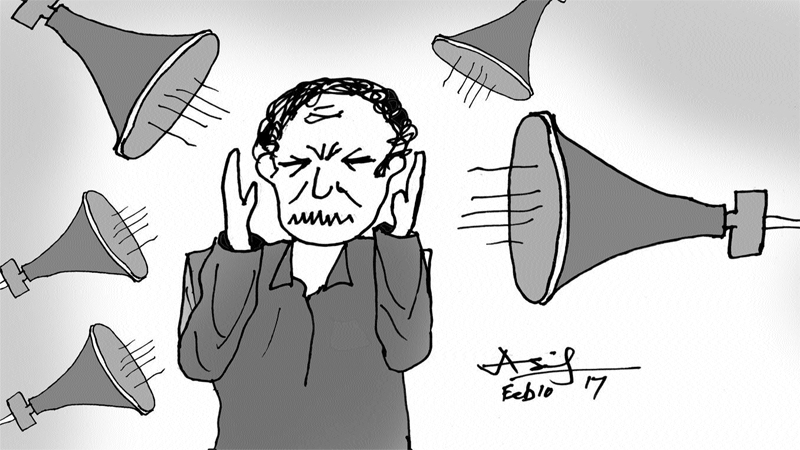
The most common problem for residents of apartment buildings is the emission of intolerable noise, particularly during quiet hours, from neighbouring apartments, together with pollutants and odours. Such examples include the continuous barking of a dog kept in a common area, the music played at very high volume by a young student, the smoke from a large barbecue installed by someone on their balcony in breach of urban planning provisions, the pollutants from the chimney of an adjacent workshop, or the rising damp on the wall caused by a fault in the plumbing system of the neighbouring apartment.
In these or similar cases involving noise emissions, we may seek protection under the provisions of the Civil Code (AK) on infringement of personality or disturbance of possession, by initially filing an application for interim measures and subsequently a regular lawsuit, requesting the cessation of the infringement of our personality or the disturbance of our possession, the prohibition of any future infringement or disturbance, with the parallel threat of a monetary penalty for each future violation.
The provisions of neighbour law (rooted in the law of “neighbourhood”) introduce lawful restrictions (delineations) on ownership, aimed at the effective protection of private interests. They are introduced to safeguard the exercise of rights flowing from the ownership of the emitting party, while at the same time defending the owners of neighbouring properties.
Of particular interest here is, on the one hand, the provision of Article 1003 of the Civil Code (AK), which provides that the owner of immovable property has an obligation to tolerate the emission of smoke, soot, fumes, heat, noise, vibrations or other similar effects originating from another property, provided that these do not significantly impair the use of their property or originate from a use customary for properties in the area of the estate from which the harm is caused. The provision of Article 1004 AK is also examined. The vital living space is also protected by the provisions of Articles 1004 and 1005 AK. In particular, Article 1004 AK permits the complete removal or prohibition of the operation of an installation from whose existence or use unlawful effects on the neighbouring property are threatened with certainty.
What is an emission?
The concept of emission is interpreted by case law rather broadly and indicatively includes positive emissions, such as for example emissions of fluorine, sounds, chemical gases, ash, dust, music, etc., but not, according to one view, the obstruction of view or related negative interferences.
What is a neighbouring property?
The concept of “neighbouring property” is legally ambiguous. A neighbouring property is – broadly construed – not only one in the sense of an adjoining property, but all properties from which an effect may be brought to bear on the owner’s property.
From the provision of Article 1003 AK there arises an obligational duty to tolerate emissions that adversely affect the property[5], if they do not substantially impair the use of the property, or even if they substantially impair it, provided they originate from a use customary for the area of the harming party — something which is interpreted restrictively in the direction of non-tolerance where there is a violation of the constitutional requirement of a sustainable vital living space. Under no circumstances should the constitutional right of the owner to enjoy their property in a healthy living space be extinguished.
How do I protect myself? The negative action under Article 1108 AK as an action of “neighbour law” and the action for disturbance of possession under Article 989 AK
The provision of Article 1108 of the Civil Code (AK) provides that “if ownership is infringed in any manner other than by removal or detention of the thing, the owner is entitled to demand from the person who infringed the ownership that the infringement be removed and refrained from in the future. A further claim for damages under the provisions on torts is not excluded. The right under the preceding paragraph is not granted if the person who committed the infringement acted by virtue of a right.” Ownership is affected — that is, the owner’s authority over the thing is delineated (and consequently restricted) inter alia by lawful limitations imposed by provisions of private or public law, by virtue of which sometimes the positive content of ownership is restricted, and at other times the negative content of ownership is delineated, namely the owner’s authority to exclude any action of another upon the thing, by obliging the owner to tolerate a certain action of a third party on the corporeal object.
In parallel, disturbance of possession exists where the possessor is not deprived of the thing but continues to maintain possession of it, that is, it constitutes any infringement of possession by means other than dispossession. As is reasonable, the owner of the affected property, in order to protect themselves against the owner of the harming property, is entitled to bring against the latter either the negative action under Article 1108 AK or the action for disturbance of possession under Article 989 AK, including the protection of possession through interim measures proceedings. The owner of the affected property is required to prove the harmful effect, and the defendant, in order to be discharged, is obliged to prove that the nuisance from their property does not exceed the limits set out in Article 1003 AK. The drafting of these lawsuits requires a lawyer.
- See also the article Tenant Eviction
- See also the article Interim Measures
- See also the article Payment Order
- See also the article Divorce
- See also the article Certificate of Inheritance
- See also the article Renunciation of Inheritance by a Minor
- See also the article Joint Custody of a Child
FREQUENTLY ASKED QUESTIONS ON NOISE EMISSIONS – LAWYER
1. What exactly am I facing when my neighbour causes noise?
This constitutes an unlawful infringement of your ownership and personality, falling within the provisions of neighbour law in the Civil Code (AK). Under Article 1003 AK, the owner of immovable property is required to tolerate only customary emissions that do not significantly impair the use of their property. However, when noise, odours, pollutants or vibrations exceed that threshold and disturb your vital living space, particularly during quiet hours, an unlawful effect arises. Typical examples include the continuous barking of a dog, music at excessive volume, smoke from a balcony barbecue, or fumes from the chimney of a neighbouring workshop.
2. What can I do to stop the nuisance?
In urgent cases, an application for interim measures is filed with the Single-Member Court of First Instance, so that the immediate cessation of the nuisance may be ordered. Subsequently or in parallel, a regular lawsuit is brought — the negative action under Article 1108 AK or the action for disturbance of possession under Article 989 AK — by which one seeks the removal of the infringement, its forbearance in the future, and the threat of a monetary penalty for each future violation. In parallel, a claim for damages may be joined under the provisions on torts, if you have suffered material or moral damage. In certain cases, a complaint to the police or to the urban planning authorities is also useful.
3. How long does the protection process take?
Interim measures proceedings move quickly: the hearing is usually scheduled within a few weeks to two months from the filing of the application, and the judgment is issued shortly thereafter. In particularly urgent circumstances, a temporary restraining order is granted on the same or the following day. A regular lawsuit for the protection of ownership or possession typically lasts from one to two years at first instance, depending on the court’s caseload. Timeframes may vary if expert evidence is required, for instance the measurement of sound levels or technical examination of emissions.
4. What evidence and documents do I need?
You will need evidentiary material that documents the intensity, frequency and duration of the nuisance. Useful items include audio or video recordings, decibel measurements, photographs, a logbook recording incidents with times and dates, witness statements from other residents or neighbours, copies of police call records, and any medical reports if your health has been affected. Also required are the title of ownership or the lease agreement, the apartment building regulations, and any written notice you have already addressed to the neighbour. The more complete the file, the stronger your position before the court.
5. What are my chances of succeeding in court?
When the nuisance demonstrably exceeds the limits of Article 1003 AK and does not constitute customary use for the area, the chances of success are significant, particularly in interim measures proceedings. Case law interprets the concept of emission broadly and gives weight to the protection of the owner’s vital living space. The defendant bears the burden of proving that the nuisance remains within permissible limits, which is difficult when there is clear evidentiary material. The final outcome depends on the quality of the evidence, the intensity of the nuisance in relation to the use of the area, and careful legal grounding.
6. What is the role of the lawyer in such cases?
The lawyer initially assesses whether the nuisance exceeds tolerance limits and selects the appropriate route of protection — interim measures, negative action, action for disturbance of possession, or action for infringement of personality. The lawyer drafts the extra-judicial notice, which often suffices to compel the neighbour to comply, and organises the evidentiary material. ZIAMPARAS D. & ASSOCIATES has expertise in cases of neighbour law and apartment buildings, handles all stages from pre-litigation communication to representation before the court, and ensures that the judgment to be issued will be enforceable, with an effective threat of monetary penalty for future violations.