

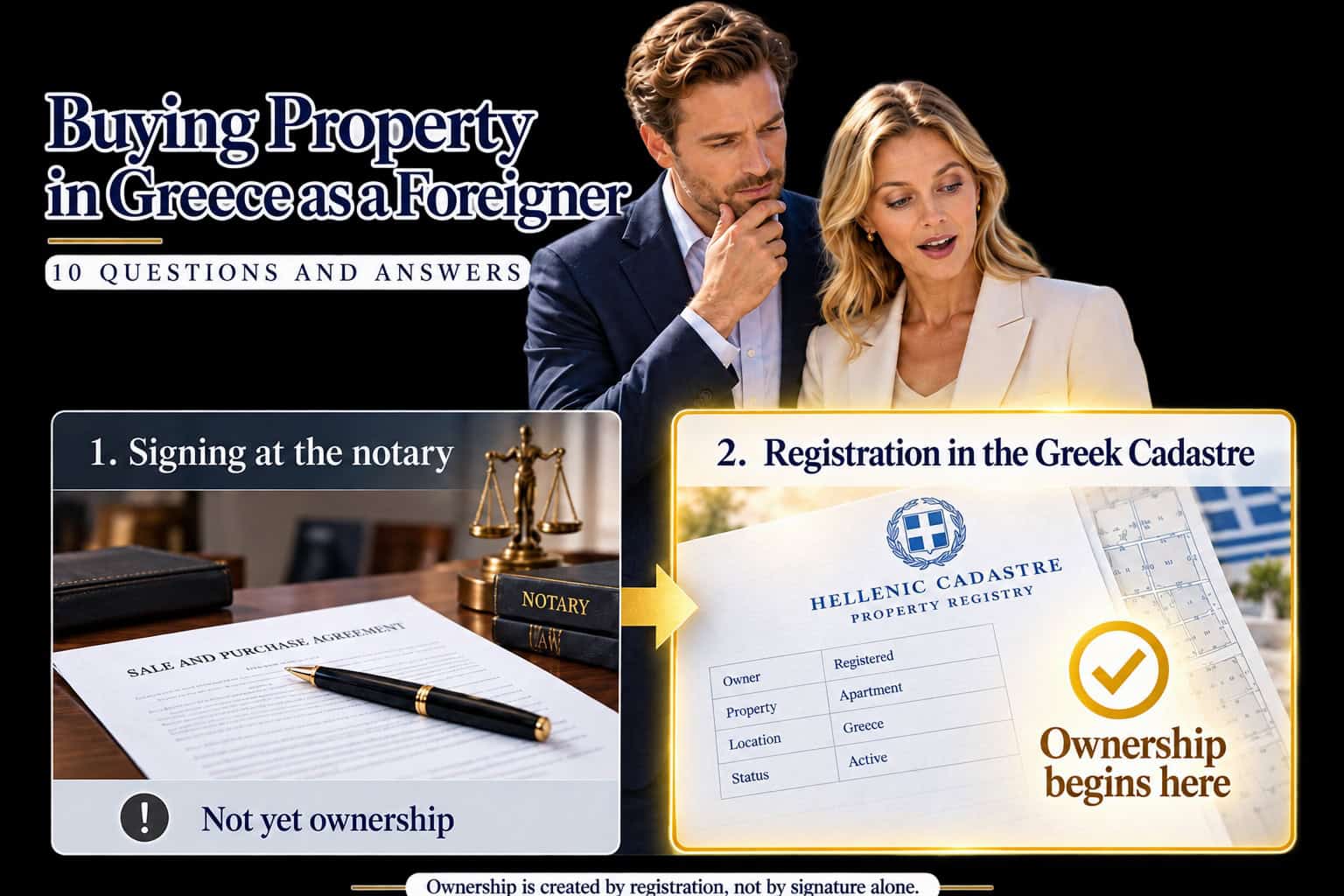
Buying property in Greece as a foreigner is legally straightforward in principle and demanding in detail. A foreign buyer, whether a citizen of the European Union or a national of a third country, meets a system with its own particular features: statutory “objective” property values, a cadastre that is gradually replacing the old mortgage registries, border areas subject to a permit regime, mandatory payment through the banking system, a Greek tax number and a tax representative, and a dedicated residence permit for investors. The ten questions below are the ones almost every foreign buyer asks before purchasing a home, a plot of land or commercial premises in Greece.
1. Can a foreigner buy property in Greece?
Yes. Greek law imposes no nationality requirement for owning real estate. Citizens of the European Union and the European Free Trade Association buy on exactly the same terms as Greeks, anywhere in the country. Nationals of third countries, including the United Kingdom, the United States, Canada, Australia, China, Israel or Turkey, also buy freely, with one exception: in the border areas defined by Law 1892/1990, such as the Dodecanese, Lesbos, Chios, Samos, Corfu, Santorini, Skyros and Thrace, a prior lifting of the statutory prohibition by the competent Decentralised Administration is required, failing which the contract is void.
The border-area prohibition (Articles 24 to 31 of Law 1892/1990) covers every transaction inter vivos by which a natural or legal person from outside the European Union and EFTA acquires a right in rem or a contractual right over real estate, so not only a purchase but also a long lease or a usufruct. The areas are defined by reference to old administrative divisions rather than to distance from a frontier, which is why they include Santorini and Astypalaia but not Crete. The list covers the former prefectures of the Dodecanese, Evros, Thesprotia, Kastoria, Corfu, Kilkis, Lesbos, Xanthi, Preveza, Rhodope, Samos, Florina and Chios, the islands of Thera (Santorini) and Skyros, and the former provinces of Nevrokopi in Drama, Pogoni and Konitsa in Ioannina, Almopia and Edessa in Pella, and Sintiki in Serres.
The lifting of the prohibition is requested by application to the committee established under Article 26 of Law 1892/1990 at each Decentralised Administration, with a file of supporting documents prescribed by Ministerial Decision Φ.114/497810/2024. The committee assesses the identity and background of the applicant, the purpose of the acquisition and national-security criteria. The procedure usually takes several months and the deed cannot be signed before the decision is issued. A deed executed without the lifting is void by operation of law. The prohibition also catches companies seated outside the Union, even where their shareholders are Europeans, while conversely a third-country national who also holds the citizenship of a member state buys freely. Checking the buyer’s citizenship and the seat of the buyer’s company is therefore the first step of any transaction on an Aegean island, in Corfu or in Thrace.
2. What does a foreign buyer need before the contract?
A Greek tax number (ΑΦΜ), the appointment of a tax representative if the buyer is tax resident abroad, a banking route for paying the price and, if the buyer will not attend, a notarial power of attorney. A Greek bank account is not legally required but is useful in practice. Foreign documents are accepted with an Apostille under the Hague Convention and an official translation into Greek.
The tax number is needed for every act concerning real estate, from the transfer-tax return to registration at the Cadastre. It is issued by the Independent Authority for Public Revenue (ΑΑΔΕ) on an application through the “ΑΦΜ and Access Key” service of the myAADE portal, filed by the applicant or an authorised person, on the basis of a passport or identity card. A person who is tax resident abroad appoints a tax representative in Greece, usually the buyer’s lawyer or accountant, who receives communications from the tax authority without becoming liable for the client’s taxes. Issuance takes a few days to two weeks.
A Greek bank account is not required by law, since the price can be transferred directly from an account abroad to the seller’s account. It does make it easier to pay utility bills, the annual property tax and building service charges, and opening one involves an identification procedure that banks apply strictly to non-residents: passport, proof of home address, proof of income or occupation, and the tax identification number of the country of residence.
Finally, identity and language. The notary verifies the identity of the parties and, if the buyer does not speak Greek, either an interpreter takes part in the execution of the deed or the buyer is represented under a power of attorney, as explained in question 9. Powers of attorney, civil-status certificates and corporate documents from abroad are accepted provided they bear an Apostille or, for countries outside the Hague Convention, consular legalisation, and are accompanied by an official translation.
3. What are the steps of a purchase and how long does it take?
Five stages: choosing the property and agreeing the price, legal and technical due diligence, a preliminary contract with a deposit, filing and paying the transfer tax, and signing the final deed before a notary followed by registration at the Hellenic Cadastre. Ownership passes only on registration, not on signature. A straightforward purchase takes four to eight weeks, while border areas and properties with pending issues take months.
The property is often found through an estate agent. The law requires a written brokerage agreement (Article 200 of Law 4072/2012), the commission is freely negotiable and in practice runs at around 2% of the price plus VAT from each side. Legal and technical due diligence follows, as described in the next question, and takes one to three weeks. After the checks, and never before them, a preliminary contract is signed with a deposit, usually 10% of the price, which binds the seller not to sell to a third party until the final deed. A notarial preliminary contract offers greater security because it can be enforced by court judgment, whereas a private agreement only grounds a claim for the return of the deposit or damages.
In the fourth stage the notary assembles the documents of seller and buyer, since 2024 largely through the Electronic Property Transfer File (akinita.gov.gr), files the transfer-tax return on the myPROPERTY platform, and the buyer pays the tax before signing. The fifth stage is the execution of the final deed, payment of the price by bank means and the application for registration at the competent Cadastral Office.
The last step is the decisive one. Under Greek law (Articles 1033 and 1198 of the Civil Code and Article 12 of Law 2664/1998 for cadastred areas) ownership does not pass on signature but on registration of the deed at the Cadastre or, where the Cadastre is not yet operating, on transcription at the mortgage registry. Until then the buyer holds only a contractual claim, which is why the application for registration is filed immediately, as a rule on the same day, priority is determined by the date of the application, and the registration certificate is kept together with the deed. Land outside the town plan, properties with planning irregularities, unsettled successions or purchases in border areas can take several months.
4. What does the lawyer check before the purchase?
Four areas: title and encumbrances at the Cadastre or the mortgage registry going back at least twenty years, planning compliance through the engineer’s certificate and the Electronic Building Identity, the building status and restrictions affecting plots and rural land (town plan, buildability, forest maps, foreshore, archaeology), and the seller’s tax and other pending obligations (ENFIA property tax, tax clearance, service charges, building regulations).
The title search follows the chain of transfers for at least twenty years, the period of extraordinary adverse possession, and confirms that the seller is in fact the owner, that any succession has been registered through a deed of acceptance of inheritance, and that the property is free of mortgages, pre-notations of mortgage, seizures, claims and pending lawsuits. In cadastred areas the lawyer also checks that the area and boundaries in the cadastral sheet agree with the title deeds, because discrepancies are common and correcting them requires a separate, sometimes judicial, procedure.
Planning compliance is evidenced by an engineer’s certificate (Article 83 of Law 4495/2017) that there are no unauthorised constructions or that any existing ones have been brought within a regularisation scheme, and by the Electronic Building Identity. The buyer must understand what regularisation means: an unauthorised construction that has been “settled” remains in many cases unauthorised for thirty years or permanently, without any possibility of full legalisation, with consequences for future building, insurance and resale.
For plots and rural land the check extends to building status: inside or outside the town plan, minimum plot requirements and buildability, classification on the published forest maps, foreshore and beach zones, archaeological restrictions, protected areas, watercourses. A property sold as “buildable” that turns out to be forest land or below the minimum plot size is the most frequent cause of loss for foreign buyers, especially on the islands.
Finally, the seller’s pending obligations: an ENFIA certificate for the last five years, a tax clearance certificate, a social-security clearance where required, a municipal certificate on the property fee, a certificate from the building manager on service charges, an energy performance certificate and, for apartments, the building regulations, which may prohibit uses such as short-term letting or professional premises.
5. What taxes and costs apply to the purchase?
Transfer tax of 3.09% on the higher of the price and the statutory objective value, paid by the buyer before the deed. The 24% VAT on new buildings remains suspended until 31 December 2026. Add notary fees starting at 0.80% on a sliding scale, Cadastre registration fees of roughly 0.5%, and lawyer’s and estate agent’s fees, all plus VAT. In total a buyer should budget roughly 8% to 10% on top of the price.
The real estate transfer tax is charged at 3% of the value, increased by a 3% municipal surcharge on the amount of the tax, so 3.09% in total. The taxable value is the higher of the agreed price and the objective value produced by the ΑΑΔΕ system of statutory values. The first-home exemption requires, among other things, permanent residence in Greece and certain citizenships or residence statuses, so a foreigner living abroad is as a rule not entitled to it.
For new buildings sold by a developer under a building permit issued after 1 January 2006, the law provides in principle for 24% VAT instead of transfer tax. Its application has been suspended by successive extensions, the current one running to 31 December 2026, and the government has announced that it is considering a further extension into 2027, so that new builds too are taxed at 3.09%. A buyer of a new build should confirm that the developer has placed the specific property under the suspension, because that is done on the developer’s own application.
Notary fees are calculated on a sliding scale starting at 0.80% of the value, plus 24% VAT and fixed charges. Registration fees at the Cadastre come to roughly 0.5% of the value plus VAT. The lawyer’s fee is freely agreed and in transactions with foreign buyers usually runs between 1% and 1.5% because of the additional volume of work, plus VAT. Add the estate agent’s commission, an engineer’s fee for a technical survey where needed, and translation costs. Buying with a loan from a Greek bank is possible for non-residents too, under stricter criteria and at a lower loan-to-value ratio, and adds the cost of registering a pre-notation of mortgage.
6. How is the price paid, and what about proof of the source of funds?
Exclusively through the banking system, by transfer or bank cheque, from a Greek or a foreign account, never in cash. The notary, the lawyer and the bank ask for evidence of the source of funds under anti-money-laundering legislation. The Greek deemed-income rule on the acquisition of assets does not apply to a person who is tax resident abroad and earns no income in Greece (Article 33 of the Income Tax Code).
Payment of the price in cash is prohibited regardless of amount, and the notary records in the deed the details of every payment, date, bank and accounts. The rule serves three purposes at once: combating tax evasion, anti-money-laundering compliance and the protection of the buyer, who obtains full proof of payment. The transfer can be made from an account abroad directly to the seller’s account or through a Greek account of the buyer.
Notaries, lawyers and banks are obliged entities under Law 4557/2018 and ask for documentation of the origin of the funds: tax returns, salary statements, the contract of sale of another property, bank statements, deeds of inheritance or gift. This documentation is prepared before the funds are transferred, not afterwards. For nationals of certain countries, in particular Russia and Belarus, European Union sanctions regimes restrict banking transactions and the feasibility of completing a purchase is examined in advance.
The question that concerns foreign buyers most is the Greek “source of wealth” presumption. Under Article 33 point η of the Income Tax Code, the deemed-income rule on the acquisition of assets does not apply to an individual who is tax resident abroad, provided that the individual earns no income in Greece. A buyer who lives abroad and has no Greek income is not asked by the Greek tax authority to justify the origin of the price. If, however, the buyer does earn income in Greece, for example rent from another property, the presumption is triggered and is covered by proof that the funds were brought in from abroad through the banking system. A transfer from abroad, with its supporting documents, is therefore both the means of payment and the tax shield.
7. Does buying property give the right to live in Greece (Golden Visa)?
Not automatically. Ownership creates no right of residence, and third-country nationals may stay for up to 90 days in any 180-day period. The investor’s permanent residence permit (Golden Visa) is granted for the purchase of property worth €800,000 in Attica, Thessaloniki, Mykonos, Santorini and islands with more than 3,100 inhabitants, €400,000 elsewhere, or €250,000 for a conversion to residential use or a listed building, with a minimum of 120 sq m in the first two categories and a ban on short-term letting.
Citizens of the European Union live in Greece freely. Third-country nationals with visa-free access may stay for up to 90 days in any 180-day period in the Schengen area, whether or not they own a home in Greece. The investor’s permanent residence permit (Article 100 of Law 5038/2023, as amended by Law 5100/2024) links residence to investment in real estate. Since 31 August 2024 three thresholds apply: €800,000 for the Region of Attica, the Regional Unit of Thessaloniki, Mykonos, Santorini and any island with more than 3,100 inhabitants, €400,000 for the rest of the country, and €250,000 for a property converted from another use to residential or for a listed building being restored. In the first two categories the investment must be in a single property with a minimum main-area floor space of 120 sq m. The property may not be offered for short-term letting, the price must be paid in full by bank means before the application is filed, and a property that has already served for a permit under the €250,000 threshold cannot be re-used under the same threshold by another investor.
The permit is granted to the investor and to family members, the spouse, children up to 21 and the parents of both spouses, lasts five years, is renewable for as long as the investment is retained and requires no minimum period of stay in Greece. On its own it does not lead to naturalisation, which requires, among other things, seven years of lawful and actual residence, adequate knowledge of Greek and integration. For nationals of certain countries issuance is subject to restrictions flowing from Union sanctions regimes.
Alternative routes for those who wish to live in Greece without an investment of that size are the financially independent person permit and the digital nomad visa, both conditional on sufficient stable income from abroad. For those who move their tax residence, the Income Tax Code provides the regime of Article 5A, a flat annual tax of €100,000 on all foreign-source income, conditional on an investment of at least €500,000 in Greece, towards which the purchase of a property counts, and the regime of Article 5B for foreign pensioners, a flat 7% rate on foreign-source income.
8. What are the tax obligations after the purchase?
Updating the property register (form E9), the annual ENFIA property tax on the objective value and, if the property is let, an annual Greek tax return with tax at 15% up to €12,000, 35% up to €35,000 and 45% above. Short-term letting requires registration, is subject to local restrictions and counts as a business from the third property. Companies holding real estate pay a special annual tax of 15% unless they qualify for an exemption, chiefly by disclosing the individuals who ultimately control them.
The declaration of the property on form E9 is now largely pre-filled from the transfer-tax return, but it remains the owner’s responsibility to verify the data, because ENFIA is calculated on them. ENFIA is assessed every year on the objective value, with a main tax and, for large holdings, a supplementary tax, and is paid in monthly instalments. For an ordinary apartment it amounts to a few hundred euros a year, while for high-value properties on islands or in the Athens suburbs the figure is considerably higher.
Rental income is taxed separately in Greece at 15% up to €12,000, 35% from €12,001 to €35,000 and 45% on the excess. A person tax resident abroad files an annual return in Greece for Greek-source income and relies in the country of residence on the applicable double taxation treaty. Commercial leases additionally bear a digital transaction fee of 3.6%. Leases are declared electronically to the ΑΑΔΕ.
Short-term letting requires registration in the Short-Term Stay Property Register and the declaration of every stay. With up to two properties the income is taxed as rental income, from the third property it is treated as business activity with VAT and the other obligations of an enterprise. In the 1st, 2nd and 3rd municipal districts of the Municipality of Athens no new registrations are permitted until 31 December 2026, a corresponding restriction applies in central Thessaloniki from 1 March 2026, and in those areas the registration number does not transfer with the property. A property acquired for a Golden Visa is excluded from short-term letting altogether, and the building regulations may prohibit it as well.
Anyone considering a purchase through a company, Greek or foreign, must be aware of the special real estate tax of Law 3091/2002: 15% per year on the objective value for legal entities holding real estate in Greece, unless they qualify for an exemption, chiefly by disclosing the individuals who ultimately control them and having those individuals obtain a Greek tax number. A corporate structure also adds accounting and administrative costs and is worthwhile only for specific reasons, such as commercial exploitation or succession planning with several beneficiaries.
9. Can a foreigner buy remotely, without travelling to Greece?
Yes. The whole process, from the tax number to registration at the Cadastre, can be carried out under a notarial power of attorney executed at a Greek consulate or before a foreign notary with an Apostille and an official translation. If the buyer attends but does not speak Greek, an interpreter takes part in the deed. The price is always paid directly by the buyer to the seller.
A power of attorney for the purchase of real estate must be notarial and must describe the property or at least the criteria for selecting it, the maximum price and the powers of the attorney: signing the preliminary and final contracts, filing tax returns, applying for registration, collecting documents and, where relevant, applying for the lifting of the border-area prohibition. When executed at a Greek consulate it is a Greek public document and needs neither Apostille nor translation. When executed before a foreign notary it bears an Apostille under the Hague Convention or, for countries that have not acceded to it, consular legalisation, and is accompanied by an official translation into Greek.
The attorney is usually the buyer’s lawyer. The same person must not also represent the seller, and payment of the price does not pass through the lawyer’s account but is made directly from the buyer to the seller, so that the bank-payment requirement is met and anti-money-laundering issues are avoided. The buyer receives a certified copy of the deed, the Cadastre registration certificate and the proofs of payment of taxes, documents needed for every later act, from letting to resale or succession.
If the buyer prefers to attend but does not speak Greek, the Notarial Code (Article 10 of Law 2830/2000) provides for the participation of an interpreter, chosen by the party and sworn before the notary. The deed is drawn up in Greek, but a translation can be requested for the buyer’s records.
10. What happens on resale or inheritance of the property?
A resale follows the same procedure, and the 15% capital gains tax is suspended until 31 December 2026. Succession is governed by Regulation (EU) 650/2012, meaning the law of the deceased’s last habitual residence unless a will chose the law of nationality. Greek property is always taxed in Greece, with a tax-free amount of €150,000 for the spouse, children and parents and rates of 1% to 10%, while a lifetime parental gift is exempt up to €800,000.
A foreign seller needs a tax clearance certificate, a five-year ENFIA certificate, an engineer’s certificate, the Electronic Building Identity and an energy performance certificate. The 15% capital gains tax on the difference between acquisition cost and sale price, provided for in Article 41 of the Income Tax Code, is suspended until 31 December 2026 with an extension under consideration, so a private seller is currently not taxed in Greece on the gain, though the gain may be taxable in the country of residence under the applicable double taxation treaty. Repatriating the proceeds abroad is unrestricted, subject to the same documentation the bank requires for any large transfer.
In matters of succession the Greek authorities apply Regulation (EU) 650/2012, even where the deceased was a citizen or resident of a country outside the Union. The estate, including the Greek property, is governed by the law of the country of the deceased’s last habitual residence, unless the deceased chose the law of their nationality by will. A choice of law by will is the most useful planning tool, because Greek succession law provides for a forced share in favour of children, spouse and parents that cannot be excluded by will. A will drawn up abroad is recognised in Greece but must be published by a Greek court before any act concerning the property.
Whatever the applicable law, the heirs accept the inheritance by a notarial deed registered at the Cadastre and file an inheritance tax return in Greece for the Greek property, which is taxed here regardless of the residence of the deceased or of the heirs. For the spouse, children and parents the tax-free amount is €150,000 per heir and the rates rise from 1% to 10%, for siblings, grandchildren and other second-category relatives from 5% to 20% with a tax-free amount of €30,000, and for non-relatives from 20% to 40% with a tax-free amount of €6,000. A lifetime parental gift or donation of the property to a spouse, children, grandchildren or parents is exempt up to €800,000 per beneficiary and taxed at 10% on the excess, which is why it is often preferred as a planning tool.
Buying property in Greece as a foreigner is no riskier than buying in any other European country, on one condition: that the checks come before the commitment. The losses that end up in court almost always begin in the same way, a deposit paid before title and planning were checked, a “buildable” plot that was not, a preliminary contract without an expiry date, a deed that was not registered in time. With the steps taken in the right order, the Greek system offers one of the most secure titles in Europe: a public deed, a public register and a tax paid in advance that ties the declared price to the real one.
- See also article Sale of Real Estate
- See also article Fraud against Property Buyers by Sellers
- See also article Action for Division of Real Estate
- See also article Acquisitive Prescription
- See also article What is the KAEK?
- See also article Prenotation of Mortgage
- See also article Eviction of Tenant
- See also article Professional and Commercial Leases
- See also article Correction of Manifest Error – Unknown Owner – National Land Registry